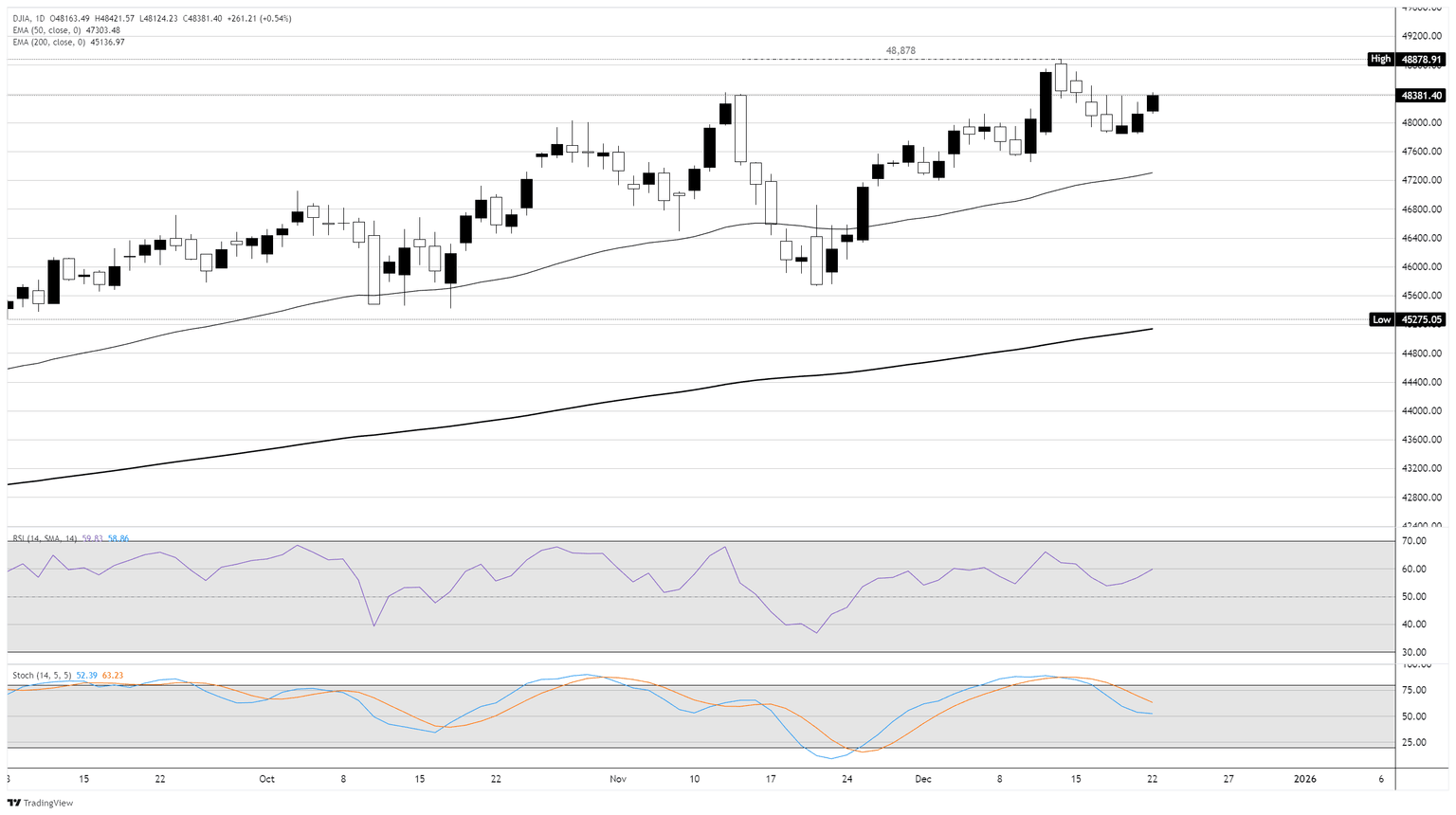
The Dow Jones Industrial Average (DJIA) gained ground on Monday, heading into the Christmas holiday schedule on the front foot as equity markets tilt into the bullish side to wrap up the trading year. Stocks tied to the AI trade rose, with big boosts coming from both the financial and materials sectors.
Stocks rally to wrap up 2025
Equity markets are twisting into the high side to wrap up the remainder of the 2025 trading window in hopes of sparking a last-minute Santa Clause rally, but time is running out with stock markets slated to be shuttered early this week. The New York Stock Exchange (NYSE) will be closing early at 1800 GMT (1300 EST) on Wednesday. Volatility could rise heading through the holidays, but overall market momentum is likely to remain muted into the new year as investors sideline themselves.
Following the Federal Reserve’s (Fed) third straight interest rate cut earlier this month, ‘real economy’ stocks are taking a step higher, with the construction materials sector climbing nearly 1.5% on Monday. The banking segment also rose 1.3% as financials take a step higher on hopes for further interest rate easing.
Data reactions remain muted following shutdown data gap
Overall market reaction to the latest inflation figures remains muted, despite a headline easing in key inflation figures. Looking deeper into the latest Consumer Price Index (CPI) report, market trepidation at the numbers is a given: The US government’s long-winded shutdown early in the fourth quarter suspended data collection at federal agencies, sparking a void in key inflation datapoints. Specifically, rents and shelter cost inflation clocked in at 0.0% for the latest reporting period, a functional impossibility as US housing remains in what most analysts refer to as an ‘affordability crisis’.
Despite eagerly leaning into further rate-cut expectations, investors are holding off on making any decisions on the back of the latest CPI inflation report, which is broadly chalked up as a wash for many analysts thanks to the shutdown data void. Policymakers at the Fed will likely view the latest inflation figures with the same level of skepticism.
US ADP Employment change and Gross Domestic Product (GDP) growth figures are due on Tuesday and will serve as the final spurt of US economic data before the holiday shutdown. The ADP 4-week average last clocked in at a relatively disappointing 16.25K, implying that ongoing weakness in the US labor market is likely to continue. On the growth front, Annualized US GDP for the third quarter is expected to slow to 3.2% from 3.8%, flying in the face of Trump administration staff who have been suggesting that American growth could accelerate to 4-5% heading into the end of the year.
Dow Jones daily chart
S&P 500 FAQs
The S&P 500 is a widely followed stock price index which measures the performance of 500 publicly owned companies, and is seen as a broad measure of the US stock market. Each company’s influence on the computation of the index is weighted based on market capitalization. This is calculated by multiplying the number of publicly traded shares of the company by the share price. The S&P 500 index has achieved impressive returns – $1.00 invested in 1970 would have yielded a return of almost $192.00 in 2022. The average annual return since its inception in 1957 has been 11.9%.
Companies are selected by committee, unlike some other indexes where they are included based on set rules. Still, they must meet certain eligibility criteria, the most important of which is market capitalization, which must be greater than or equal to $12.7 billion. Other criteria include liquidity, domicile, public float, sector, financial viability, length of time publicly traded, and representation of the industries in the economy of the United States. The nine largest companies in the index account for 27.8% of the market capitalization of the index.
There are a number of ways to trade the S&P 500. Most retail brokers and spread betting platforms allow traders to use Contracts for Difference (CFD) to place bets on the direction of the price. In addition, that can buy into Index, Mutual and Exchange Traded Funds (ETF) that track the price of the S&P 500. The most liquid of the ETFs is State Street Corporation’s SPY. The Chicago Mercantile Exchange (CME) offers futures contracts in the index and the Chicago Board of Options (CMOE) offers options as well as ETFs, inverse ETFs and leveraged ETFs.
Many different factors drive the S&P 500 but mainly it is the aggregate performance of the component companies revealed in their quarterly and annual company earnings reports. US and global macroeconomic data also contributes as it impacts on investor sentiment, which if positive drives gains. The level of interest rates, set by the Federal Reserve (Fed), also influences the S&P 500 as it affects the cost of credit, on which many corporations are heavily reliant. Therefore, inflation can be a major driver as well as other metrics which impact the Fed decisions.