Gold (XAU/USD) sticks to intraday gains near a two-week top heading into the European session on Friday, with bulls awaiting a sustained move beyond the $4,200 mark before placing fresh bets. The increasing likelihood of another interest rate cut by the US Federal Reserve (Fed) in December turns out to be a key factor that continues to benefit the non-yielding yellow metal. The intraday move up could also be attributed to technical buying above the $4,170-4,175 hurdle.
Meanwhile, the US Dollar (USD) looks to build on the overnight bounce from an over one-week low and acts as a headwind for the Gold. Apart from this, the prevalent risk-on environment, bolstered by the prospects for lower US interest rates and hopes for a Russia-Ukraine peace deal, contributes to capping the safe-haven precious metal. Nevertheless, the XAU/USD pair remains on track to register strong weekly gains and seems poised to prolong its weekly uptrend.
Daily Digest Market Movers: Gold continues to be underpinned by dovish Fed bets
- The recent dovish remarks from several Federal Reserve officials suggested that another interest rate cut in December is a live option. Moreover, a mixed set of US economic indicators released this week did little to alter expectations, pushing the non-yielding Gold to a two-week high during the Asian session on Friday.
- Adding to this, reports suggest that White House economic adviser Kevin Hassett has emerged as the frontrunner to become the next Fed Chair and is widely expected to enact US President Donald Trump’s calls for sharply lower interest rates. This offsets a modest US Dollar uptick and also acts as a tailwind for the commodity.
- Russian President Vladimir Putin said that the revised US proposal could form the basis of a future Ukraine agreement, but only if Ukraine pulls its troops out of areas Moscow claims as its own. Putin also warned that Russia will take the territory by force if Ukraine refuses. Ukraine has repeatedly said it will not give up any land.
- Meanwhile, Kremlin spokesman Dmitry Peskov cautioned that an agreement is a long way off and Moscow would offer no major concessions. Trump, however, said that a Ukraine–Russia agreement is very close. Nevertheless, this keeps geopolitical risks in play and further benefits the precious metal’s safe-haven status.
- The supporting factor, to a larger extent, offsets a modest uptick in the US Dollar, which is looking to build on the overnight bounce from a one-and-a-half-week low. Even the risk-on environment fails to dent the bullish sentiment surrounding the commodity. This, in turn, backs the case for additional near-term gains.
- There isn’t any relevant market-moving economic data due for release from the US on Friday, leaving the XAU/USD pair at the mercy of Fed rate cut expectations and the broader risk sentiment. The fundamental backdrop, however, suggests that the path of least resistance for the commodity remains to the upside.
Gold could accelerate positive momentum once $4,200 hurdle is cleared
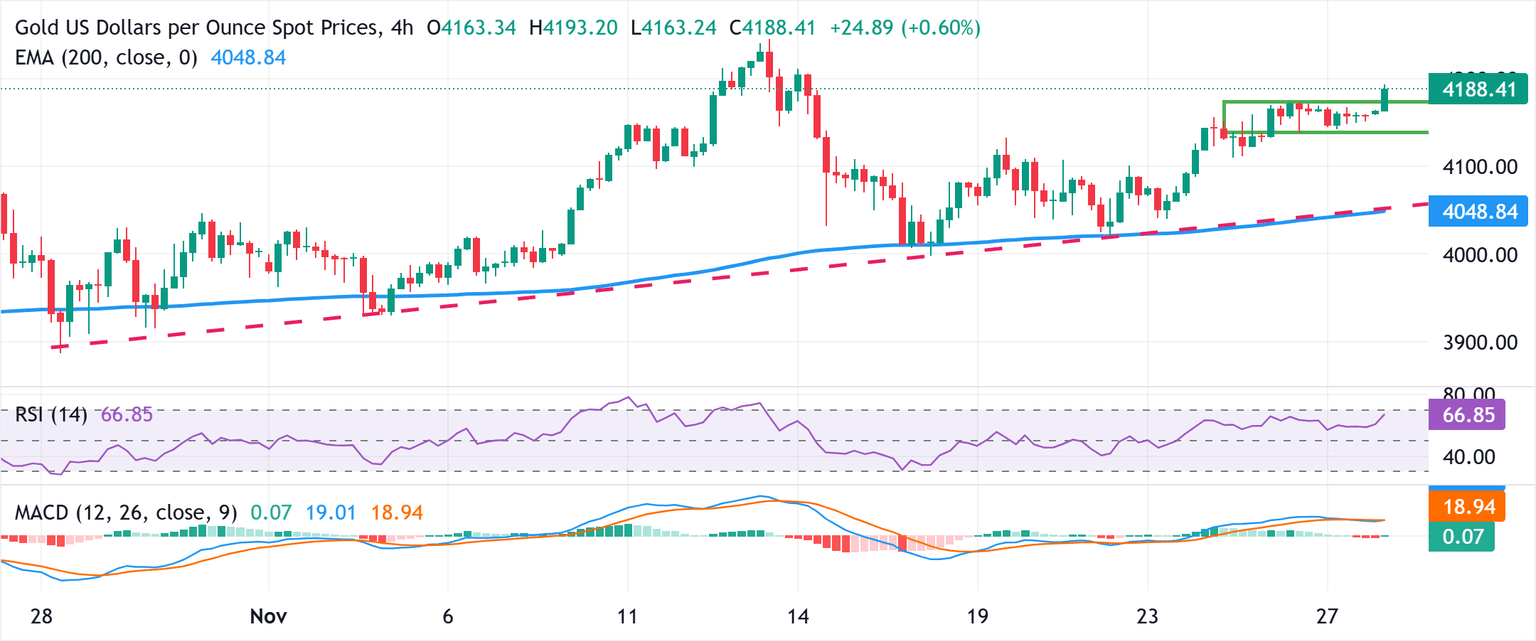
The latest leg up confirms a breakout through a consolidative trading range and validates the near-term positive bias for the Gold price. Some follow-through buying beyond the $4,200 mark will reaffirm the constructive outlook and lift the commodity further towards the monthly swing high, around the $4,245 region. A sustained strength beyond the latter will be seen as a fresh trigger for bullish traders and set the stage for an extension of the recent move up witnessed over the past week or so.
On the flip side, weakness below the trading range hurdle breakpoint, around the $4,175-4,170 region, now seems to find decent support ahead of the $4,150 level. A convincing break below, however, might drag the Gold price to the $4,120-4,115 intermediate support en route to the $4,100 mark, which, if broken, would expose the $4,050-4,040 confluence. The latter comprises the 200-period Exponential Moving Average (EMA) on the 4-hour chart and an ascending trend-line extending from late October. Failure to defend the said support level will negate the positive outlook and pave the way for deeper losses.
Fed FAQs
Monetary policy in the US is shaped by the Federal Reserve (Fed). The Fed has two mandates: to achieve price stability and foster full employment. Its primary tool to achieve these goals is by adjusting interest rates.
When prices are rising too quickly and inflation is above the Fed’s 2% target, it raises interest rates, increasing borrowing costs throughout the economy. This results in a stronger US Dollar (USD) as it makes the US a more attractive place for international investors to park their money.
When inflation falls below 2% or the Unemployment Rate is too high, the Fed may lower interest rates to encourage borrowing, which weighs on the Greenback.
The Federal Reserve (Fed) holds eight policy meetings a year, where the Federal Open Market Committee (FOMC) assesses economic conditions and makes monetary policy decisions.
The FOMC is attended by twelve Fed officials – the seven members of the Board of Governors, the president of the Federal Reserve Bank of New York, and four of the remaining eleven regional Reserve Bank presidents, who serve one-year terms on a rotating basis.
In extreme situations, the Federal Reserve may resort to a policy named Quantitative Easing (QE). QE is the process by which the Fed substantially increases the flow of credit in a stuck financial system.
It is a non-standard policy measure used during crises or when inflation is extremely low. It was the Fed’s weapon of choice during the Great Financial Crisis in 2008. It involves the Fed printing more Dollars and using them to buy high grade bonds from financial institutions. QE usually weakens the US Dollar.
Quantitative tightening (QT) is the reverse process of QE, whereby the Federal Reserve stops buying bonds from financial institutions and does not reinvest the principal from the bonds it holds maturing, to purchase new bonds. It is usually positive for the value of the US Dollar.